

Mewtwo Strikes Back Review
Although I use the English name of the movie and its characters to make the review more accessible to English-speaking fans, I was actually watching a fansub of the Japanese version of the movie. As 4Kids significantly rewrote the movie for its English-language release, there will be some differences if you have only seen the dub.
Thoughts and Synopsis
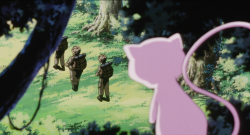
The first Pokémon movie concerns Mewtwo, the mysterious Pokémon found deep inside Cerulean Cave in the original Pokémon games with no explanation but mysterious Pokédex descriptions and some puzzling diary entries left in Cinnabar Island's Pokémon Mansion. The diary fragments explain that scientists discovered a new Pokémon deep in the South American jungle and named it Mew, and then that it "gave birth" to a Pokémon they called Mewtwo. The final, ominous entry describes Mewtwo as being "far too powerful" and that they have "failed to curb its vicious tendencies"; what happened next is never stated, but is easily inferred from the fact the Pokémon Mansion is now in ruins and Mewtwo roams free. Its Pokédex entry, meanwhile, reads "It was created by a scientist after years of horrific gene splicing and DNA engineering experiments", indicating its "birth" was far from natural. One of the most subtle, memorable and unsettling aspects of the game, it was an obvious candidate to focus on when the franchise expanded into film.
The movie both elaborates on Mewtwo's game origin and tweaks it slightly. The researchers never find a live Mew, only a fossilized eyebrow. They are funded by Team Rocket's Giovanni (though this isn't explicitly stated in the original film), and their research lab is not on Cinnabar but a remote island original to the film called New Island. Giovanni then commissions Dr. Fuji - the same man as the kindly old Mr. Fuji from the games' Lavender Town - to create a superpowered clone of Mew in return for funding his futile efforts to clone his dead daughter. Whereas Dr. Fuji's other clones never live very long, Mewtwo survives, and at the beginning of the film he wakes up inside his tank, his thoughts full of questions about his identity and purpose. He breaks the tank and converses telepathically with the scientists who created him, asking them these questions, but they tell him he is only an experiment created by humans. Upset, angry and too powerful for his own good, Mewtwo destroys the lab in a fit of rage.
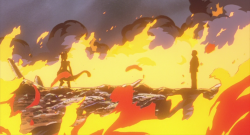
Afterwards, Mewtwo is lost and confused and doesn't quite know what to do with himself, but Giovanni has been watching all along from a helicopter, and as the lab burns behind them, he confronts Mewtwo. Giovanni says they could do great things together, but Mewtwo must learn to control and restrain his powers or he will destroy the world. Mewtwo tentatively agrees to come with him to a Team Rocket facility, where he is dressed in strange-looking metal armor that is meant to focus his powers and proceeds to easily overpower all the Pokémon that are thrown at him. But he finds no fulfillment in fighting random Pokémon; again he starts to wonder about his purpose, and when Giovanni too tells him he only exists to be used by humans, he rebels, escapes and sheds the suppressive armor. He returns to New Island, rebuilds the lab, and, determined to prove his life has some worth and meaning despite being manmade, plots to show the world - but mostly himself - that he is not only stronger than any human could hope to be, but also stronger than the original Mew.
Though Mewtwo is the antagonist and gets regretfully little development during the actual film, his character actually has some interesting depth. He wants to find a sense of identity and purpose, but feels worthless and inferior because he's an experiment created for humans to use rather than being born naturally (or, as he puts it, created by God). Since the only thing he has some sort of confidence in is his powers, he latches on to this concept of strength as a meaningful measure of his right to exist: if he's stronger than Mew, then he has to be worthy of life. Obviously this worldview is deeply misguided, but it makes sense given who he is and what has happened to him.
Thus, Mewtwo devises a way to gather the most powerful trainers in the world so that he can test his strength against theirs. He kidnaps and brainwashes the closest Nurse Joy to use as a servant, then sends out challenges to strong trainers around the world, inviting them to come to New Island to meet him, the strongest Pokémon trainer in the world. Finally, he conjures up a storm with his psychic powers in order to filter out the lesser candidates and make sure only the strongest can make it through. One of the invited trainers, of course, is Ash, and he, Misty and Brock are among only six trainers who make it to the island.
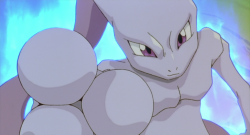
After they have arrived and been briefly introduced to the other trainers, Mewtwo finally reveals himself. He shows off his powers by psychically torturing the first trainer to vocally question him, then smirks and chuckles as he tosses him aside. Ordinarily I'd roll my eyes at this, but it actually makes sense for Mewtwo here. This is essentially his first encounter with Pokémon trainers since his brief time with Team Rocket, remember; when he was with Giovanni, he was lost and confused and just did what he was told, but now that he is serving his own goals, he finds with glee that even the supposedly strongest of the humans who created him, tried to control him and successfully control other Pokémon even now are helpless against his will. Mewtwo chuckles because he is for the first time truly feeling the magnitude of his own power over the humans standing before him, and it feels good.
After easily deflecting a Hyper Beam from that trainer's Gyarados, Mewtwo releases Joy from his control, as she has fulfilled her purpose in serving as a human front to get the trainers there. He comments on how he once tried to work with humans but was disappointed. Notice how his mind has turned things around - in reality, Giovanni tried to use and control him and he escaped when he realized he didn't want to exist as his tool. In the time since, Mewtwo has reframed it as him trying to work with humans but being disappointed by human weakness; in this framing, he has been the one in control all along, on his own terms. He even states that humans are unworthy of ruling the world like they do, but Pokémon aren't deserving either because they let the humans control them. This is projection: he is really angry at himself for almost letting Giovanni control him.
Ash's Pikachu leaps forth to protest: they're not slaves but friends to the humans. Mewtwo throws it away in frustration and responds that any Pokémon that willingly submits to a human is weak (again, notice he frames things around who is "strong" and "weak", because his worldview revolves around power). Another trainer tries to attack him with similarly pathetic results, and Mewtwo says it's no use because he is the strongest Pokémon.
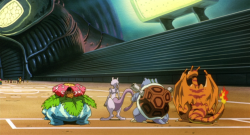
Ash says he doesn't think Mewtwo is unbeatable, and Mewtwo takes this as his cue to release the cloned Venusaur, Charizard and Blastoise he's been keeping asleep in his cloning lab and essentially challenge the trainers to a Pokémon battle - he now wants to show off his ability at the humans' own game. Since, conveniently, three of the trainers happen to have the final forms of the starters, they have three short one-on-one original versus clone battles, with the clones winning easily in each case, though Ash's Charizard puts up a bit more of a fight than the others.
Mewtwo proceeds to summon three black Pokéballs that quickly capture all three of the originals, intending to clone even stronger versions, and then calls forth even more that swarm into the room where all the other Pokémon are and capture them one by one. Ash's Pikachu resists capture the longest, although eventually it too is absorbed by a black ball, which Ash then desperately follows down into the cloning chamber. He manages to wrench the Pokéball out of the cloning machine, but not until it has already gathered the DNA to create a clone. In the process, however, he damages the machine, and once it has created clones of all the Pokémon, it explodes and releases all of the originals as well.
Meanwhile, Mewtwo stands on the arena with his three starter clones, staring at the horrified trainers. He is silent for a moment and then tells them he has decided to spare their lives, opens the great doors leading back outside and tells them to leave - with the footnote that it is still storming, and how will they leave without their Pokémon?
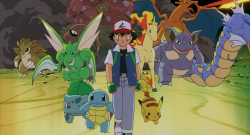
Before he manages to enforce the order, however, Ash dramatically returns with all the Pokémon, both the originals and the new clones. After declaring that he will protect his Pokémon and his friends no matter what, he runs straight towards Mewtwo and tries to punch him. By this point Mewtwo isn't chuckling - he is just annoyed, and to get rid of that pesky kid for good, he psychically throws him towards the roof of the lab.
But Ash is saved by a floating pink bubble: Mew, who woke up underwater back when Mewtwo first called up the storm and found its way to the island through either some mystical psychic instinct or plot-induced luck, has stepped in. Mew plays cutely with the bubble for a moment before Mewtwo, irritated at the sudden interruption and implicit challenge, blasts the bubble apart and begins to throw a series of Shadow Balls at Mew. At first Mew just darts out of the way of his attacks, but then, after Mewtwo has said that Mew must be afraid of him to keep dodging like that, Mew takes a Shadow Ball from Mewtwo and retaliates with a sparkling blue ball of energy of its own.
Mewtwo rises back from the rubble after being hit and declares that he underestimated Mew and now they will fight to see which of them is the "real" one. He further tells the other Pokémon that they must do the same - fight one-on-one with their counterparts to decide a "winner" who gets to live on.
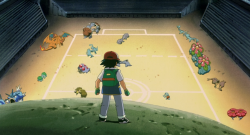
Mew finally speaks, translated by Meowth (oh, yeah, Team Rocket are there too): it says that the originals will always be the real ones, and furthermore that they will not lose to the clones, at least if they don't use their special powers. Mew has effectively accepted Mewtwo's terms. The Pokémon all do as instructed, original and clone locked in individual physical scuffles, and even Mew and Mewtwo themselves start to ram one another in mid-air inside their protective bubbles, forgoing the energy balls from earlier.
Nurse Joy, the original Blastoise's trainer and Misty and Brock stand by and watch in horror as the Pokémon exhaust themselves in a pointless fight. They realize these Pokémon are all living beings, whether they're originals or clones, and they all have the same right to live, no matter which is strongest. But the only Pokémon who refuse to fight are Team Rocket's Meowth and his clone, who mutually decide fighting hurts and they'd rather talk about the roundness of the moon, and Ash's Pikachu, whose clone beats it senselessly around with tears in its eyes, obviously hating to hurt somebody who doesn't fight back. Nurse Joy explains that in the wild, Pokémon will fight until they defeat their opponent, no matter what, and that is why they continue to fight this pointless fight - when they've been declared enemies, they won't stop until they've driven the opponent away. Thus, for as long as the clones and originals remain nominally adversaries - or, in other words, so long as Mewtwo and Mew continue to fight - they will keep on fighting.
Eventually, all the Pokémon have pretty much collapsed from exhaustion, and Mew and Mewtwo clash once more, taking out the electricity in the arena. In darkness, they ditch the no-special-attacks rule and flare up with pink and blue flames. Just as they blast energy at one another, Ash runs up in his typical recklessness, hoping to stop them, and comes between the attacks.
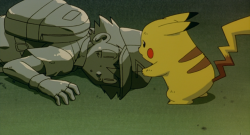
Ash collapses, suddenly turned to stone. Mew and Mewtwo stare in shock as Pikachu runs into the arena to its petrified trainer and tries unsuccessfully to prod and then shock him back to life. When all fails and Pikachu is too exhausted to produce enough electricity for a Thundershock, it just stands there and begins to cry.
At this, all the Pokémon on the arena, originals and clones alike, begin to cry as well, and somehow, it turns out getting enough Pokémon to cry is just the cure for petrification. Ash is revived, and moreover the sun also comes back, and suddenly Mewtwo realizes that he and Mew are both Pokémon and both have the same right to live. He levitates all of the clones into the air and flies off with them to find a place where they can be accepted. Meanwhile, everybody is teleported off the island and their memories of the entire incident are erased; next thing they know, Ash, Misty and Brock are back in the Pokémon Center where they were told about the storm earlier in the movie, unable to remember a thing. The storm is already clearing. Ash sees Mew in the clouds, but Misty and Brock see nothing, and Ash concludes it was the same Pokémon he saw at the beginning of his journey. Which, if you remember that far back, was actually Ho-oh and not Mew, so I suppose he's just really confused.
Meanwhile, Team Rocket are left on New Island, which is now an empty field of grass, the lab and Mewtwo's castle having disappered.
And thus the movie ends, exactly nothing having happened from our heroes' point of view.
The Good
Mewtwo is quite compelling as a character and, at least in the first half of the movie and prior to his sudden conversion by tears, has intriguing psychological depth behind his actions. The core idea behind the plot - a clone with confused ideas about personal worth trying to justify his own existence - is not bad at all; it's interesting and surprisingly heavy for a Pokémon movie, in a good way. The montage of fighting Pokémon manages pretty well to drive that sense of pointlessness and futility home on an emotional level, and something about the scene where Ash is revived, particularly Pikachu's weak, desperate attempts at the beginning, manages to be sweet and touching even despite how horribly nonsensical it is.
Then there are some pretty visuals, the music is nice (but note that the dub replaced all the music), and Mew's antics are cute.
The Bad
Unfortunately, Mewtwo's potential is mostly squandered by the utterly strange plot resolution here. The whole movie builds up Mewtwo and his misguided convictions, only to give him a sudden and inexplicable change of heart triggered by something that has nothing to do with the source of his issues. It's simply monstrously unsatisfying.
I often feel that in the Pokémon movies, the writers have a hard time figuring out how to make Ash relevant. Obviously he is the main character and needs to be a major player in resolving the plot, but a plot like "Mewtwo thinks his life is worthless unless he can show himself to be superior to Mew" doesn't lend itself well to being resolved by a headstrong kid with a tendency to run into things first and ask questions later. This often leads to large-scale epic plots about clashes between godlike beings getting resolved in contrived and anticlimactic ways in order to have Ash save the day somehow, and the first movie is definitely an example of this phenomenon in action.
To boot, the entire idea that the Pokémon's tears can magically revive Ash is a strange deus ex machina that comes completely out of nowhere. This is one place where the dub's changes are somewhat sensible - they added dialogue to earlier parts of the movie talking about Pokémon's tears giving life, in order to have some semblance of setup for this ending. But in the original Japanese version, there is no such setup whatsoever. It just happens, and whatever its possible emotional impact, it simply makes no sense.
(The later, extended version of the movie adds the "Birth of Mewtwo" short to the beginning. In it, young Mewtwo shares a telepathic vision of the outside world with the clone of Dr. Fuji's daughter Amber and the Bulbasaur, Charmander and Squirtle clones created along with her. At the end of it, the other clones start to fade away as they die; Mewtwo begins to cry, and Amber explains to him that it's said that most living creatures only cry when they're in pain, but humans are the only ones who cry when they're sad. While this addition doesn't explain at all how tears can cure petrification, it does perhaps offer something of an explanation as to why this of all things would cause Mewtwo to change his mind: assuming it vaguely jogs his memory of these events, he may have realized on seeing the Pokémon cry that actually Pokémon are capable of crying when they're sad too, whether they're originals or clones, and that somehow makes him understand that they're the same? But that's still not a very coherent reason to come to that conclusion, and of course it wasn't in the original theatrical release of the movie at all.)
Finally, it bugs me that they do this whole thing with disallowing special powers when the clones fight the originals. That's a good way to level the playing field if one side has an advantage, but... the point of this whole exercise is Mewtwo trying to prove that the clones are stronger, so by insisting the playing field needs leveling, Mew is effectively admitting that Mewtwo is right. And Mewtwo seems to take it at face value. I suppose he might want to prove that they're stronger even with a handicap, but it's odd he seems to implicitly agree that special powers don't really count for anything for some reason, even though Mew seems to imply that the clones' special powers really are superior.
Conclusion
Overall I'm reasonably fond of this movie. Mewtwo is interesting and lends himself well to the kind of analysis I enjoy, and for the first half of the movie he really drives it and makes it compelling. But in the second half it starts to fall apart, and ultimately I regard it fondly more for its potential than for what it ends up as. It's not terrible, but it could have been excellent, and unfortunately the final product simply isn't.
Next review (The Power of One) »
Page last modified August 13 2016 at 02:34 UTC