

Pokémon Genetics
One of the first things Pokémon players will notice when they start breeding Pokémon is that Pokémon reproduction works nothing like ours. In particular, Pokémon inheritance is very unusual: whereas the inheritance of IVs portrayed in the games passes as a simplification of inheritance in Earth animals, the species of a Pokémon is always identical to that of the mother. This would be plainly impossible in Earth animals, where a child inherits a random half of each parent's genome. Moreover, while the general recipe for the body is inherited from the mother, Pokémon can inherit the ability to use particular moves from the father.
In addition to the inheritance oddities, Pokémon also have varying sex ratios. While animal gender ratios can vary, the way that Pokémon gender ratios come consistently in negative powers of two - when one gender is more common than the other, the less common is always either one quarter or one eighth of the population - is curious and must be considered before being dismissed as a coincidence.
So how does this all work? What system of inheritance can get this all to make sense?
 The Structure of the Genome
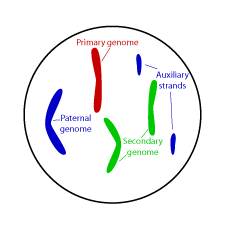
A Pokémon's genome is split into several different components:
- The primary genome is one single long strand of genetic material and contains all the information specific to this Pokémon species.
- The secondary genome consists of two paired chromosomes that work much like animal chromosomes. These are relatively uniform across all Pokémon species and are suspected to play a large role in traits all Pokémon share, such as their unusual healing ability, evolution, and other features that at a glance might appear supernatural. Genetic variation in the secondary genome causes individual differences in stats.
- The tertiary genome encompasses several strands of genetic material that originate as duplicates of a primary genome or parts of it. The tertiary genome itself is never passed on to offspring, but instead created anew when gametes are formed. Includes:
- The paternal genome, a derivative of the father's primary genome. The paternal genome is mostly inactive; however, parts of it can also in conjunction with parts of the primary genome lead to a Pokémon being born with the ability to use moves that its father could use (more on the mechanics of this later). If the paternal genome matches the primary genome (i.e. both of a Pokémon's parents were the same species), genes can cross over between the two; this facilitates genetic reshuffling within the species.
- The maternal auxiliary strands are usually small and vary in number and contents depending on the Pokémon species; however, moreover, any individual Pokémon may or may not have any of its species' auxiliary strands. The auxiliary strands are active duplicates of inactive sections of the mother's primary genome and can change the course of a Pokémon's development in a binary fashion where individuals who have some particular auxiliary strand or combination of auxiliary strands develop differently from individuals who don't. Notably, a Pokémon's sex is determined through auxiliary strands, as is the ability of Pokémon with dual abilities.
A more detailed explanation of the gametes produced by each sex and how the recombination occurs is illustrated below.
How It Works
So how does this system of genetics explain the breeding mechanics we observe in Pokémon?
The Species
The primary genome, containing all the coding for the basic body structure of the Pokémon, is passed through the female line and only mixes with homologous paternal genomes, keeping the genetic code for the species completely apart from the genes of any different-species fathers that may enter the picture.
Note that Pokémon such as Nidoran male/female and Volbeat/Illumise are often counted as different species, but are in fact the same species, in that they have the same primary gene pool. The merely have more significant differences between the sexes than most other Pokémon, with more different genes activating in only one sex but not the other. More on sex determination below.
Egg Moves
When Pokémon learn and use moves, certain normally-dormant genes in the primary genome are 'activated', promoting the skills required. Forgetting moves deactivates these genes again. This feature evolved to let the Pokémon optimize its body to perform the moves that it commonly uses in its daily life, while conserving any extra energy that would have to go into being primed to use other moves that it doesn't need. When a sperm cell is formed and the paternal imprint is established, these activated move genes are the only ones that are not suppressed.
After fertilization, the primary genome's activated move genes are normally all reset to be dormant, giving the baby a fresh start move-wise. However, if the paternal genome contains similar genes that are activated, they will interfere with this process, keeping the counterpart genes in the primary genome active. This feature evolved because in nature, both parents using the same move on a regular basis tends to mean that this is an especially useful move in the Pokémon's current environment. For certain move genes, especially ones that are sensitive to outside activation, a counterpart gene being active in the paternal genome can even activate previously inactive genes in the primary genome.
Individual Values
IVs as we see them in the games are a simplification of the ordinary animal-like inheritance pattern of the secondary genome. Because the secondary genome is inherited from both the mother and father, complex recombination occurs; however, a particularly powerful Pokémon may still give rise to particularly powerful offspring by passing on those parts of the secondary genome that made it unusually powerful.
Sex Ratios
Each given species of Pokémon with multiple sexes has a dominant sex, which an embryo will default to, and certain auxiliary strands that will turn the embryo into the other sex if they are all present in its cells. Thus, Pokémon with a fifty-fifty sex ratio have their sex determined by whether the embryo has one single particular auxiliary strand, whereas Pokémon that lean 75% towards one sex require a combination of two particular auxiliary strands to become the other one, and species such as the starters will only become female if three particular auxiliary strands are all present.
The Marill family is somewhat unusual in this regard; it is female-dominant and two of its auxiliary strands, referred to as the alpha and beta strand, are required to turn an Azurill into a male; however, a Marill or Azumarill only needs the alpha strand to become male. Because Pokémon's bodies are wholly reconstructed during evolution, this means one third of female Azurill (those that have an alpha strand but not a beta strand, as opposed to those that have only the beta strand and those that have neither) will turn male when they become Marill.
Abilities
Pokémon species that have two abilities have their ability determined by the presence or nonpresence of yet another auxiliary strand. Again, one ability is the default, whereas an auxiliary strand will modify the developmental process resulting in the Pokémon getting the other ability.
The alternate abilities most species of Pokémon can have (often known as "Dream World abilities") develop from a type of symbiotic virus that imitates an auxiliary strand; it is not broken down on egg creation but instead is passed on to one of the daughter cells.
Ditto
When a Ditto transforms, it copies the other Pokémon's primary and secondary genomes within its cells; however, its own primary genome remains and gives it the ability to produce either sex's gametes and genitalia at will. This allows it to mate with any non-genderless Pokémon. Egg cells produced by Ditto contain the borrowed primary genome and auxiliary strands created from it but half of Ditto's secondary genome, whereas sperm cells produced by Ditto are produced as in any other Pokémon. While genderless Pokémon cannot normally reproduce sexually, a Ditto that has transformed into one can usually create a mixed offspring anyway, however, using the borrowed primary genome, a paternally imprinted version of Ditto's primary genome, half of each Pokémon's secondary genome, and auxiliary strands created from the borrowed primary genome.
Gamete Formation
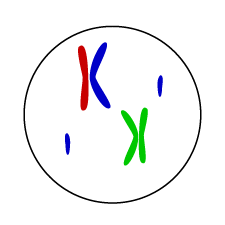
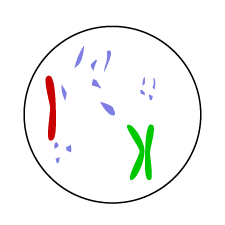
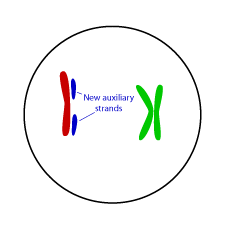
The formation of Pokémon gametes happens in several phases, much like meiosis as we know it in animals. Leaving out the parts that are irrelevant to our discussion, the processes happening during each phase are the following:
 Phase I
The maternal and paternal chromatids of the secondary genome pair up. If the primary and paternal genome are homologous (i.e. the Pokémon's father and mother were both of the same species), they also pair up. Random homologous recombination occurs between the paired chromatids.
 Phase II
The tertiary genome of the cell is destroyed in its entirety; its building blocks will be used for replication of the rest of the genome in later phases.
 Phase III
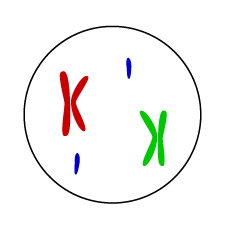
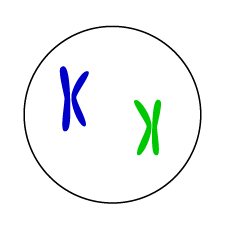
During the formation of eggs, all the auxiliary strands appropriate to the species are created at this stage by duplicating all the designated regions of the primary genome once.
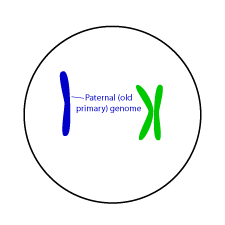 When sperm are formed, no auxiliary strands are created, but the primary genome is instead converted to be mostly-inactive in order to suppress its ability to shape the offspring once it joins with an egg. This is basically imprinting as we know it in real-world genetics on more drastic scale.
 Phase IV
The primary genome is duplicated.
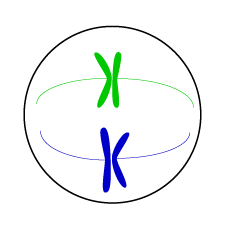 Phase V
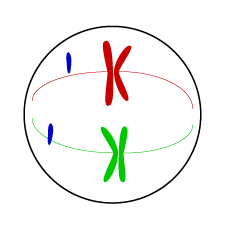
The paired chromatids of the secondary genome and the two copies of the primary genome line up near the middle of the cell.
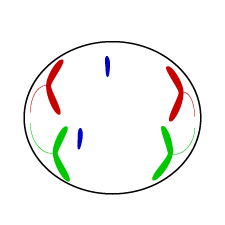
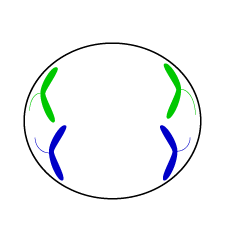 Phase VI
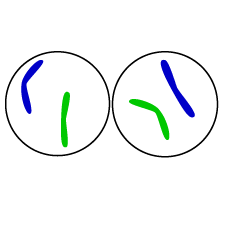
The secondary chromatids and the primary genome copies are pulled apart to opposite ends of the cell as it prepares to divide.
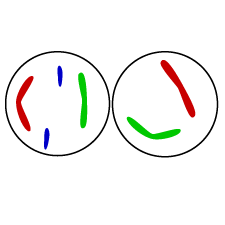
 Phase VII
The cell divides. Each daughter cell thus has a copy of the primary genome and one strand of the secondary genome. In an egg, the auxiliary strands are not systematically pulled to either end of the cell and thus each end up in either of the daughter cells at random, independently of each other.
In summary, a Pokémon sperm cell contains a mostly-suppressed (paternally imprinted) primary genome and one secondary genome strand. A Pokémon egg cell contains its primary genome, a secondary genome strand, and may contain any of its species' auxiliary strands, with approximately 50% probability for each. When a sperm and egg meet, this forms a complete genome for the child.
Page last modified November 20 2025 at 17:02 UTC
Post comment
Inflammatory or off-topic comments will be deleted; please go to the guestbook for discussion unrelated to this page. You can use BBCode (forum code) to format your messages.
Giving an e-mail address is optional; if it is given, you will be notified by e-mail if I respond to your post. If you fill in a website (this should be your own website, blog or social media profile), it will be linked publicly on your post; however, messages obviously posted solely as a pretext for advertising, or advertising shady or inappropriate websites, will be deleted.
- [b]Bold[/b]
- [i]Italic[/i]
- [u]Underlined[/u]
- [s]Strikethrough[/s]
- [url=http://www.dragonflycave.com]Link[/url]
- [spoiler]Spoiler[/spoiler]
Comments
My own messages will be signed as Butterfree, with the Admin label below my name. If someone signs as Butterfree without that label, it's probably not me.
Pages: 1


Pages: 1